Technology is actually eating our brains

Recently PISA, the leading organization in conducting comparative studies in international educational performance released some extremely shocking and worrying numbers. The current generation of children (around aged 16 right now from the study) are preforming staggeringly worse in school.
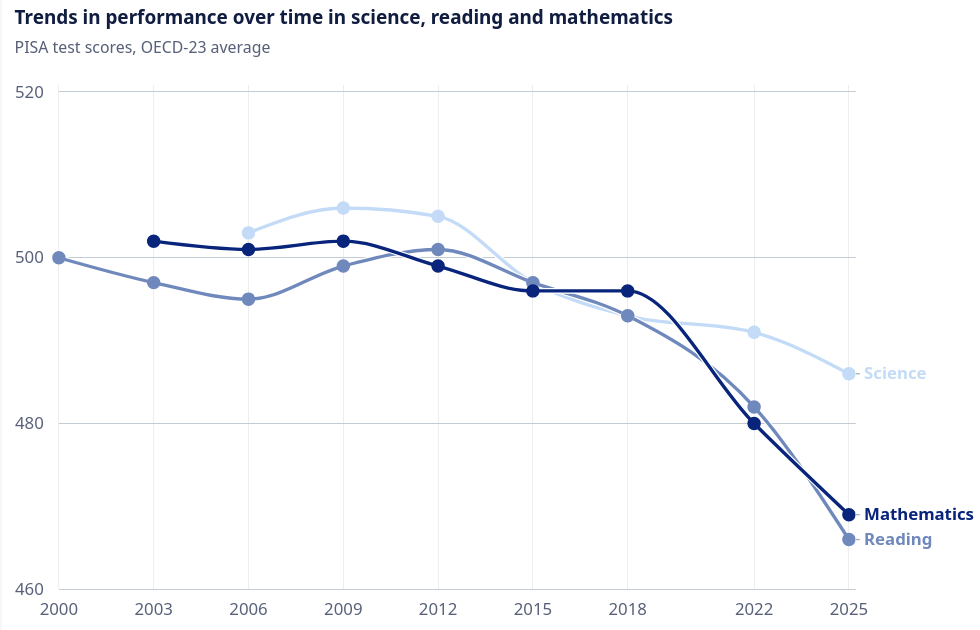
Note, here PISA specifies that a drop of 20 points is approximately equivalent to a year of later education learning. The actual individual trends from 2022 to 2025 are:
- Science: -5
- Mathematics: -11
- Reading: -16
According to PISAs own standardized tests there is a worrying new trend for how well students are learning:
Reading recorded the steepest drop, with scores falling by 28 points across OECD countries and by 16 points among other countries and economies between 2015 and 2025.
Particularly in OECD countries where technology tends to be widespread and adopted in schools. Note, not everywhere is suffering, there are plenty of places that are interesting exceptions, but I am keeping this conversation to broad trends.
What has caused this?
Well, many things (obviously). But I believe the biggest conclusive difference is electronics and AI. Note, it's easy to also say COVID has a part to play, and maybe a rebound from that is just delayed, but in 2025 I think we would have expected to see that.
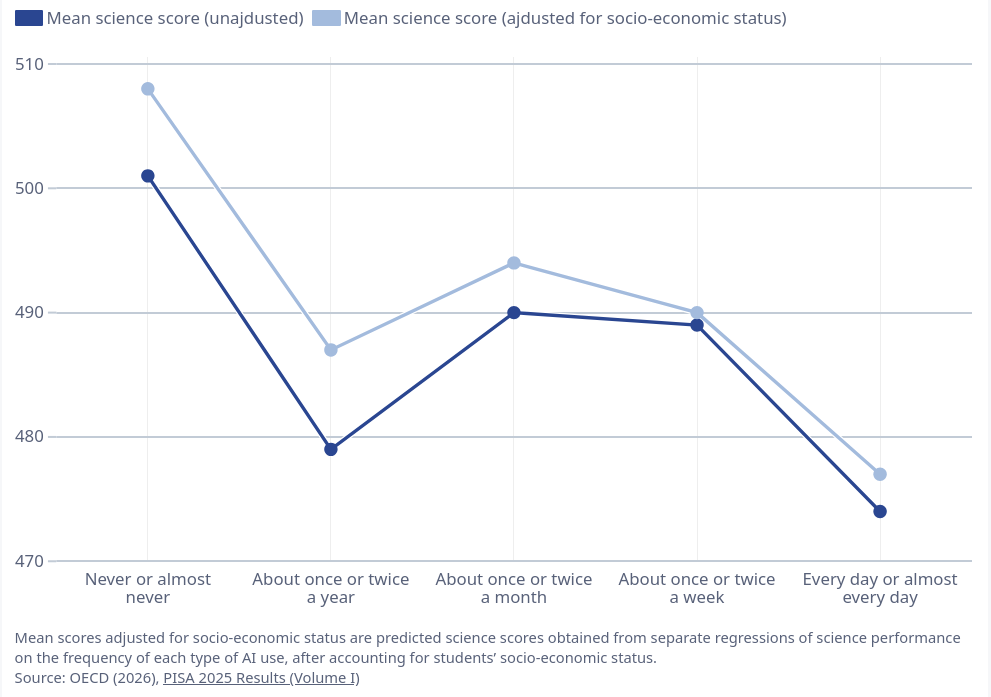
You can see some questions within the PISA report that were aimed at addressing some of this problem, such as asking students about their AI usage:
In these scenarios, students who do not use AI outperform those who do, on average, by around 20 points – equivalent to being around one year of schooling ahead of their peers.
Their report itself includes statements like:
This raises questions about whether devices such as
smartphones – designed to maximise a user’s attention – are compatible with sustained academic attention.
This is where this transitions from being mostly about data into more of a opinion piece. I will do my best to site sources, and explain myself clearly and precisely.
Don't underestimate children
My younger brother went to cartoonish lengths to get around the wants of my parents. They would store his devices in their room at night. He would sneak down and steal them back. He ended up loaning and buying an old tablet off of a friend in school and then hiding that down a crack in his bed for months. He installed operating systems, and learned passwords to screen time applications. He was impossible to keep from using social media and videogames.
What is this about though?
While that is a short setup the real point I want to make here is that technology has become incredibly addictive, dangerous, and ubiquitous for all people. And it is impacting our ability to read, rationalize, and learn severely. Brain rot is a officially recognized word by Miriam Webster as a term.
People have always thought that the activities of younger generations, such as rock-and-roll, were making them dumber, but the issue is this time it's real and backed up by evidence. So I wanted to take a moment to talk about what can feasibly be done to help prevent these issues.
What does NOT work
Policy: it doesn't seem to work
There have been a number of places who have outright banned social media:
Applications have been banned since December of 2025 and so far, the results are not encouraging:
Some 26% of children between the ages of 13 and 15 were on TikTok as of last month, just one percentage point below the rate prior to Australia's groundbreaking rules coming into effect, the parental control software maker said. The rate for children between the ages of 10 and 12 is higher now than before the ban, according to the data. - Bloomberg
“What we’ve seen is an immediate drop to a degree, but slowly but surely the numbers have started to increase again to almost equivalent levels” for some services, said Yasmin London, a global online safety expert at Qustodio. - LA Times
The truth is, policy just cannot move fast enough or be throughout enough or even understand the situations that most teens live in. I personally, do not believe blanket policies banning specific platforms is in any way a good idea for a number of reasons:
- There are many ways around technical solutions:
Children could be obfuscating their ages, using virtual private networks that disguise their locations, or simply not encountering effective age checks on platforms, London said. - LA Times - If blanket bans are effective, they just ostracize people from well moderated social media, pushing them to less well known and more dangerous platforms
- Blanket bans leave youth feeling upset because they cannot engage in something that has become a cultural experience.
- Not exposing people to social media will not let them build up a tolerance or understand how to use it effectively
Just dumping 16-18 year old people onto the platforms after years of bans does not guarantee they will be any less damaged by it moving forward, even if their education suffers less. - This just makes young people feel disrespected
Just like drinking and cigarettes, most people just scoff at these rules, and think that they are capable of handling it. And social media looks even more ridiculous being banned than those.
Changing social media behavior also doesn't work
In the same vein, Australia is considering making the algorithmic suggestions on social media optional. I think this suffers from many of the same issues, with the digital markets being so nimble many large companies like Meta will be able to simply find ways around these bans.
For example, Instagram has a truly disgusting policy currently letting users "Snoose" the suggestions in their feed for 30 days. Hidden deep in their settings, it does not work on websites, and requires 2 confirmations and a delay before the setting is enabled.
Tap Snooze to pause all suggested posts in your Feed for 30 days.
- Instagrams help section
I have little doubts that if bans were places on algorithms for say, Instagram Reels, then a few weeks later a dedicated app called Instagram Moments would pop up and emulate the experience without restrictions.
And again, this would just drive teens to other platforms the bans have yet to cover. In a world where a new social media can be created by a LLM in weeks or days this is particularly ineffective and dangerous.
What works
Screen time applications
Apple is in a key position to make screen time the most effective. And they have. Because of the walled gardens around their platforms they can incredibly effectively provide methods for both themselves and third party application to:
- Prevent children from downloading unauthorized applications without express permission, or uninstalling apps
- Prevent children from visiting unauthorized or unknown websites and applications, and using devices at unauthorized times
- Share detailed analytics about time spent and where
- Truly and effectively prevent getting around these measures
(By doing things such as rooting and installing a separate, unrestricted operating system, account, ect)
This in incredibly powerful. It lets parents react at the speed their child can discover harmful content at. Along with this it can be personalized to each child. Instead of saying that they cannot participate, it gives children a chance to do so, for short periods, in a controlled environment. It's a truly effective way.
For me, the single most effective application I've used has been ScreenZen. It is free, packed with all the features needed to take advantage of the tools above, and is the only way I personally can use social media without abusing my time on it.
Combined with this, for my computers I use ZenBlock. A simple and effective re-implementation of the ScreenZen delay method for browsers.
Androids screen time applications
Android also has ScreenZen, and FamilyLink, their child management service. It has most of the tools, but it seems to be easier to bypass.
For example factory resetting a device does not seem to require administrator access. And does not seem to give proper permissions to stop children from deleting applications.
Along with this, if a Android phone can be rooted, there is the possibility that kids can get around these restrictions. This is a complicated topic because I stand strongly for having a open boot-loader that can allow third party operating systems to be installed, but these kinds of things need proper security walls built into them.
Along with this, Chromebooks seem to have issues ignoring rules like this, a laughable flaw for Googles supposedly locked down and heavily controlled operating system.
Computers are more problematic, and the real issue I want to talk about
Apple, once again, has this covered (better at least). But if you have any faith in Microsoft I would be worried for you, not to dismiss them out of hand but they are actually such a joke. Here is a list of issues I've found with one google search:
- To use Microsoft Family Safety, you must create a Microsoft account specifically for your child, even if you are monitoring an 8-year-old child. Microsoft Family Safety cannot be used with local user accounts (offline accounts) .
- Windows Copilot or Edge Copilot cannot be disabled. As much as you might want to prevent your child from using Bing or ChatGPT's AI when they're just learning to write, it's impossible.
- You cannot disable the news feed that appears in new tabs in Microsoft Edge unless you disable Bing.
- The Microsoft search button cannot be disabled. The search button surprisingly shows up a lot of tabloid content. Mr. Sieben points out that even if you set the content displayed in your child's account in Microsoft Family Safety to ``only allowed websites'', it is a problem that tabloid content is displayed from the search button.
- It is also not possible to disable widget buttons in Windows 11. The purpose of the widget is clearly 'to provide tabloid content,' and like the search button, even if you set the content displayed on your child's account in Microsoft Family Safety to 'Only allowed websites', tabloid content will not be displayed. cannot be blocked.
- Windows 11 comes with pre-installed apps for movies, TV, Xbox, news, etc. Even if you open these apps individually, display them on the dashboard, and then block them with Microsoft Family Safety, it seems that they cannot be blocked correctly.
- Microsoft Family Safety does not allow you to disable the Microsoft Store, but it does allow you to set age restrictions. Therefore, Sieben says,
It's best to block all apps that are ratedfor ages 3 and up.'' - Microsoft Office allows you to embed content from Bing, which is not restricted by parental controls. For example, if you block Bing, the internet filter only works in Microsoft Edge, so your child can watch any video by embedding it in Word.
Many major browsers lack any kind of parental control features:
Most Browsers:
Firefox, chromium, edge, and safari all are missing many features out of the box that would let parents help manage their kids screen time. This is incredibly frustrating because for most people, their main use case on a computer is browser based.
Kahf Browser
There is a notable exception called Kahf Browser but it has limited platform support, is targeted towards Muslim audiences, and has some features I find problematic, like automatic AI based image filtering.

Chrome and Family Link
Google Chrome also has built in parental features through their Family Link features. Along with ChromeOS this offers a compelling way to help manage kids. ChromeOS actually enables you to run full Linux environments in your system, allowing you to install packages you normally wouldn't think work with their sandboxed ecosystem. This is incredibly frustrating because Google has such a monopoly in this space, but honestly not that problematic for most people.
Linux is surprisingly barren
Linux is difficult to lock down in many ways. Because there are no real userland standards then solutions struggle to really be complete in locking down environments. And compared to the sandboxed and well funded approaches mentioned above that already have poor implementations I'm doubtless these are even more vulnerable.
Ubuntu Parental Controls
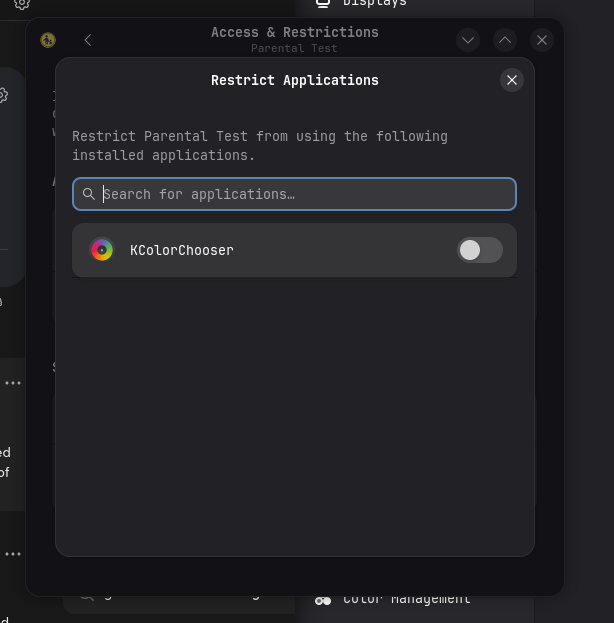
This is very intuitive, and has some really strong key features. This includes limiting applications. But, it is not very strong. It is mostly limited to managing a couple of key features like restricting web browsers, applications, app installation, and filtering for a set of blessed applications suited for children. This is strong, but also a little fragile. I don't think there is that much that can be done given the lack of true standards for userland Linux. For example, on my Arch device the only available application is the only one I had to install through flatpacks (KColorChooser). Everything else is installed with pacman and therefore not something it can manage. If you don't have problems with Ubuntu, maybe this wouldn't be an issue.